
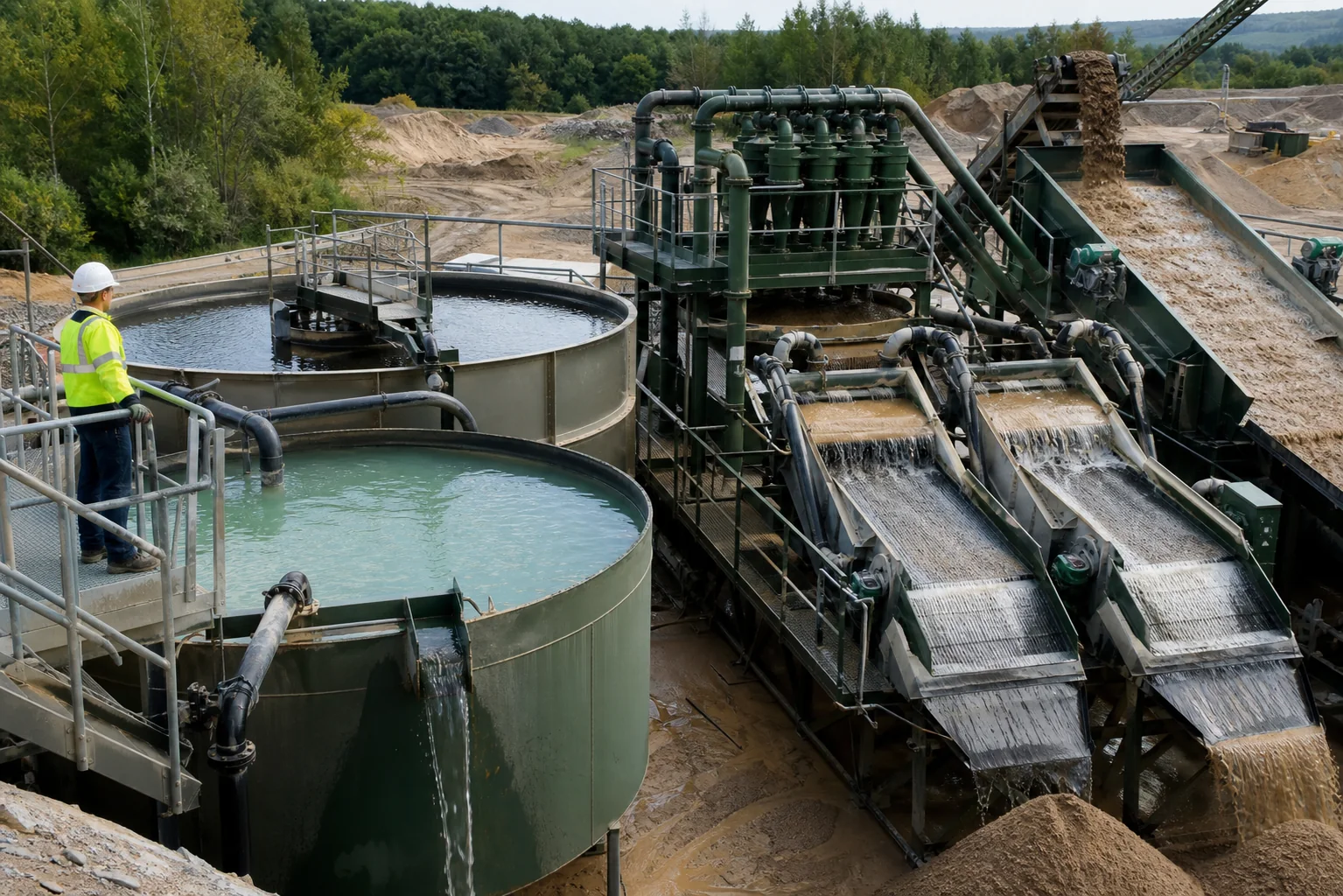
Define the purchase decision
Clay-rich wash water can change sharply between extraction faces. Procurement needs a candidate that handles the defined fines and recycle-water envelope rather than a product selected on one unusually sandy sample.
Keep the proposed product identity connected to the tested suspension and the intended separator.
Preserve the difficult fines fraction
Record quarry face, wash conditions, solids concentration and particle information where available. Homogenize and split samples consistently so coarse settling does not leave different clay concentrations in each test. Compare a normal sample and the relevant difficult clay-rich feed.
The selection method keeps candidate differences separate from sample preparation errors.
Use established recycle water
Test at the actual recycle ratio and water chemistry. Fresh makeup water alone can miss concentrated ions or accumulated fines. Keep stock-water and slurry-water changes distinguishable using the chemistry comparison.
A higher-anionicity label should not substitute for this evidence; particle attachment and water composition must support the candidate.
Accept the water and mud together
Measure recycle clarity, settling, settled inventory and sludge withdrawal or filtration. Record whether fine-solids return affects washing or product recovery. Large water-rich aggregates can look successful while loading the sludge circuit beyond its practical capacity.
Include qualified consumption and makeup-water consequences when comparing commercial value, rather than unit powder price alone.
Check a misleading apparent improvement
If a clay-rich feed needs much more product than the original sand-rich sample, do not average the two doses into a universal quotation claim. Establish whether one profile can meet both duties over a controllable window. Keep any alternative grade and its change condition separately qualified and identifiable.
Retain the comparison conditions and any unresolved acceptance requirement with the proposed purchase.
Set the release boundary
Approve the tested extraction and water conditions. Keep an alternate profile only if independently qualified and define when operators should request a new screen instead of automatically increasing dose.
| Purchase requirement | Required evidence | Release condition |
|---|---|---|
| Feed | Normal and clay-rich split samples | Qualification includes the difficult fines |
| Water | Established recycle chemistry | Trial reflects the operating circuit |
| Handling | Clear water plus workable sludge | Purchase does not move the bottleneck |
Send a focused commercial request
Send quarry-feed changes, solids data, recycle conditions, separator and sludge-handling constraints. State the water-quality measurement that limits washing performance.
Include quantity, package and destination with the sample and RFQ record. Review quality and supply controls with Gongyi Xinqi Polymer Co., Ltd.; confirm grade-specific terms and availability before ordering.
Request a product and supply review
Send the suspension, treatment route and proposed purchasing scope.