
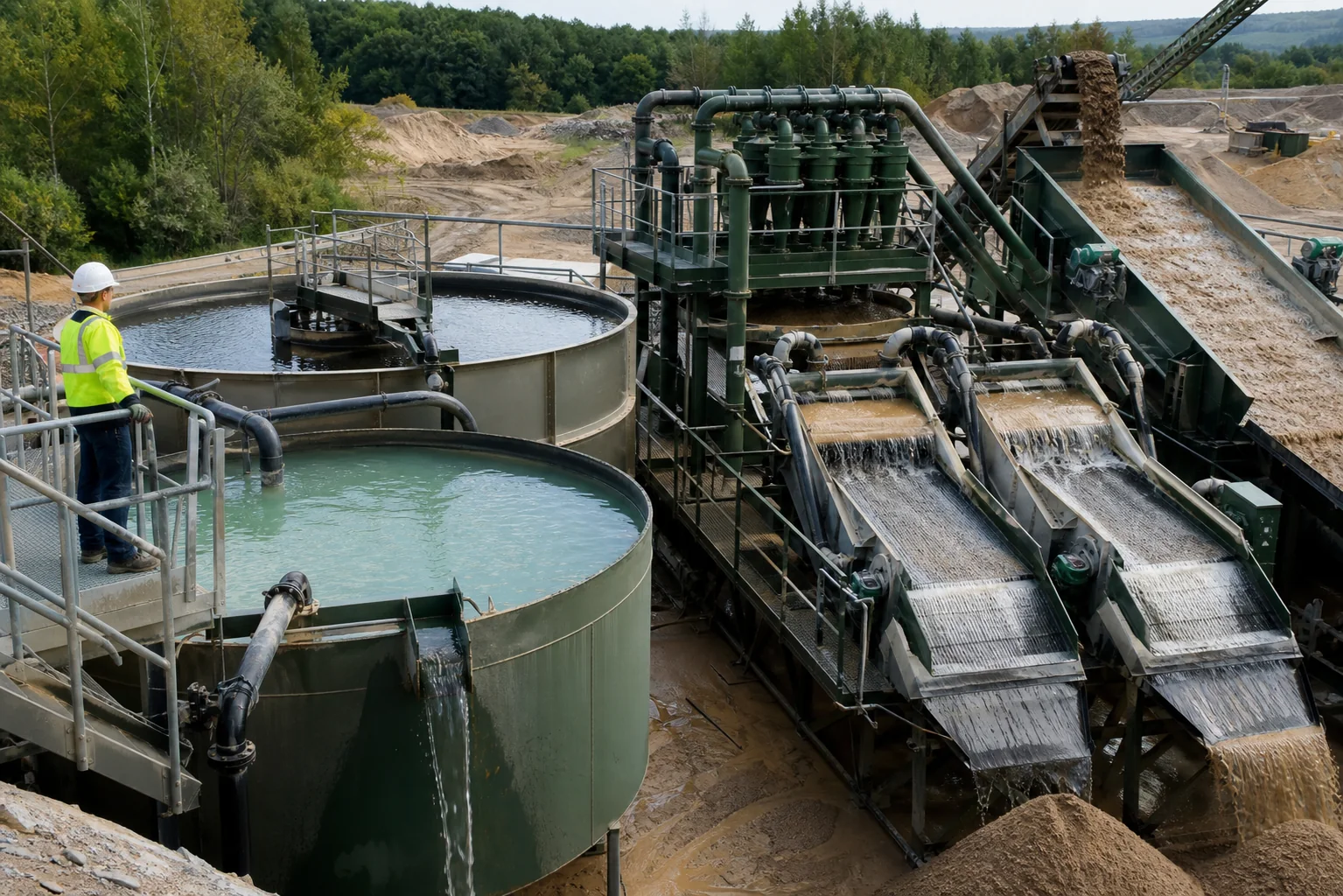
Map the recirculating load
Record wash-water flow, recycle ratio, solids, particle size, clay mineral response, pH, conductivity and changes between extraction faces. Closed-loop systems accumulate fine solids and dissolved ions that a once-through jar test may miss.
Sample both fresh feed water and established recycle water. Note rain events, plant cleaning and product changes that alter the suspension.
Test for reusable water
Run dose curves at the actual process-water chemistry. Measure settling interface, supernatant turbidity, sludge volume and drainage or pumping behavior. Include a sample of current recycle water as the blank baseline.
The best visual floc may not provide the lowest fine-solids return to hydrocyclones and screens. Use the parameter that limits washing performance.
Control preparation and injection
Hydrate powder fully and dilute the stock enough for distribution. Locate injection upstream of a contact zone without sending the new floc through unnecessary pumps or violent elbows.
Calibrate solution flow and dry-solids loading. A fixed pump setting will change active dose when wash-water solids or plant throughput changes.
Plan for quarry variability
Keep at least two adjacent polymer profiles qualified when clay and hardness vary substantially. Establish signs for moving dose within the approved range before changing product.
Track recycle clarity, sludge withdrawal, clean-water demand and polymer mass per tonne processed. Review the whole water circuit rather than optimizing one settling cylinder.