
Confirm why elevated charge is in the test set
High anionicity can change adsorption and chain conformation where dissolved multivalent ions or positively conditioned surfaces support attachment. It is not a universal answer for every negatively charged mineral suspension.
Record pH, conductivity, hardness, dissolved metals, clay fraction and process reagents. Use these measurements to explain the response rather than attaching a permanent label to the ore.
Compare equal-active-dose profiles
Hold molecular profile as close as practical while anionicity changes. Prepare each sample under identical conditions and apply the same mixing history. Include an adjacent lower-charge grade to show whether the extra ionic character creates useful separation.
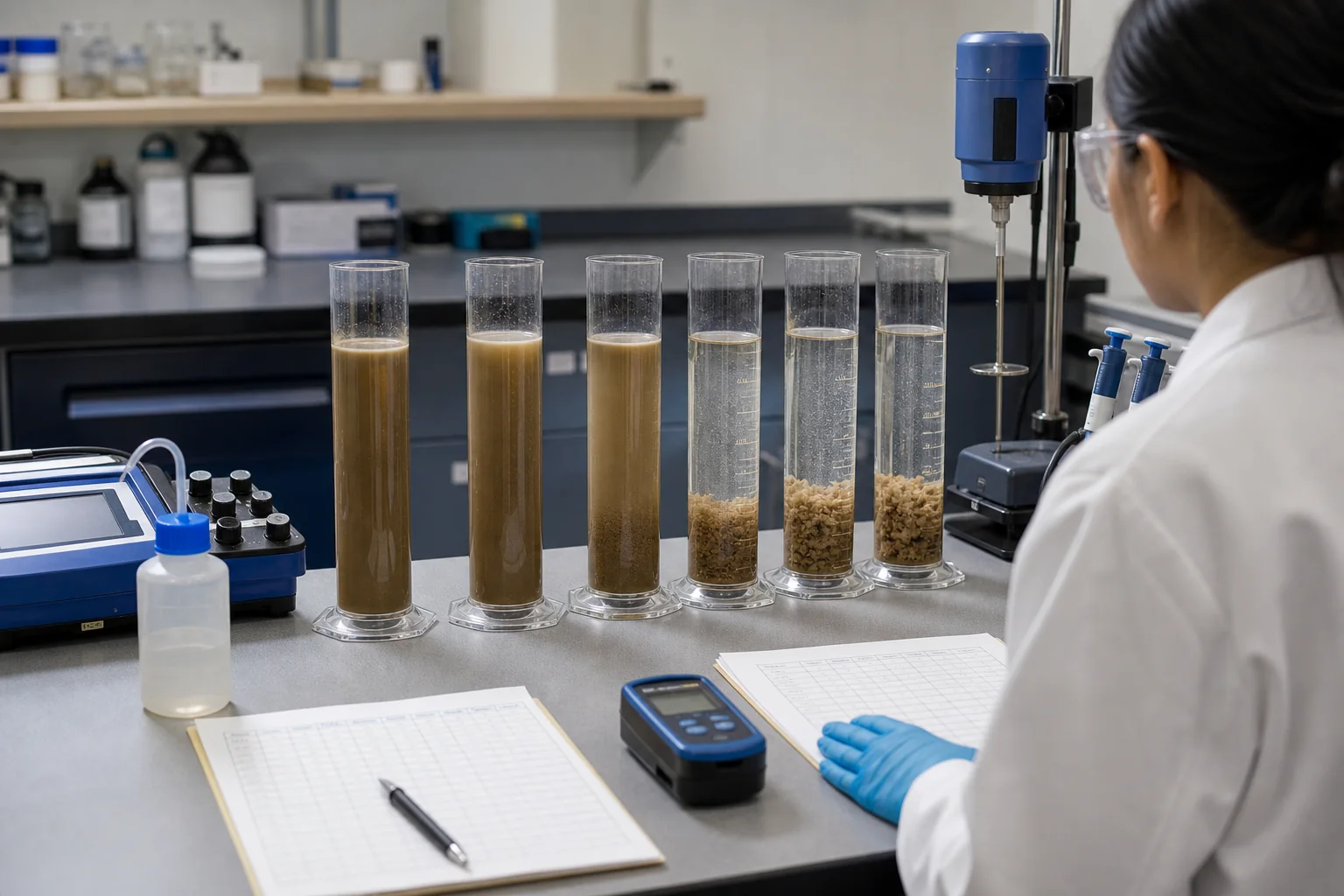
Measure settling velocity, overflow turbidity, compacted volume and floc strength. Note wall effects in small cylinders and repeat the result before scale-up.
Locate restabilization and dispersion
Too much polymer or an unsuitable surface interaction can leave fine particles suspended even when some large aggregates appear. A declining overflow result at higher dose is a reason to move back down the curve, not to keep increasing feed.
Inspect distribution as well as chemistry. Concentrated stock contacting a small fraction of slurry can create overdosed and untreated zones in the same pipe.
Qualify the grade and batch together
Retain the approved powder and prepared solution. Record lot, moisture or active basis, preparation time and test water. Compare later supply on the same reference slurry where practical.
Commercial approval should include product identity, application result, COA fields, packaging integrity and delivered treatment cost at the operating dose.