
Treat the product name as a class
Anionic polyelectrolyte identifies a negatively charged water-soluble polymer family, not one universal grade. Molecular architecture, ionic character, product form, preparation and suspension chemistry all influence the process result.
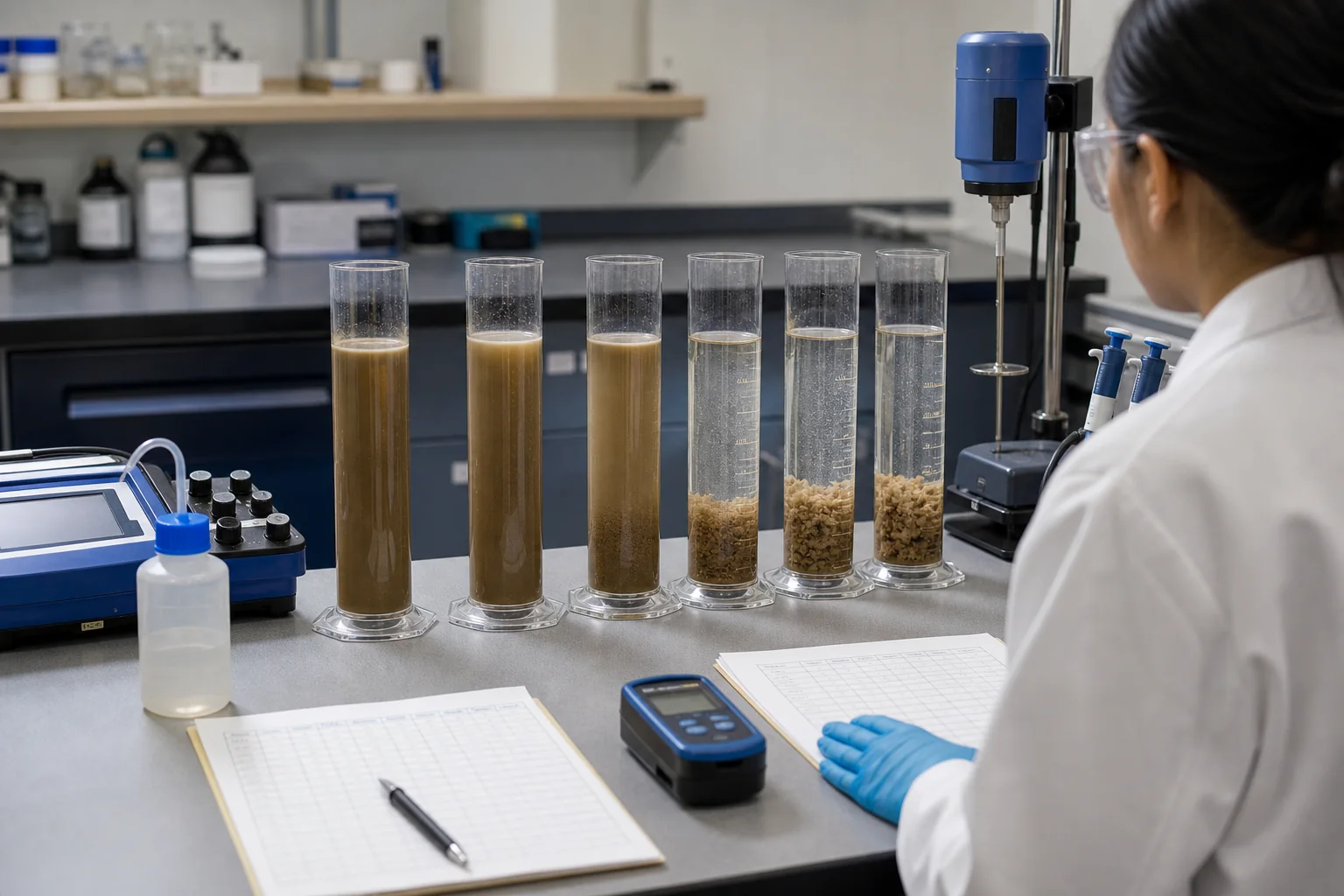
Use a short adjacent candidate set that makes the effect of charge and molecular reach interpretable. Keep active dose and test history constant.
Match the surface and water chemistry
Record particle origin, mineral or coagulant surface, pH, conductivity, hardness, dissolved metals and upstream reagents. An apparent grade preference can reverse when process water changes.
Screen in the actual water and repeat across normal and difficult feed. Use clear sample codes rather than relying on descriptive labels alone.
Approve performance, not the largest floc
Measure the endpoint that controls the process: clarified-water quality, settling flux, compacted bed, filtration, recycle load or equipment stability. Add a controlled shear step when the floc passes through pumps or feedwells.
A useful selection record connects product code and lot to preparation, active dose, feed condition and measured output.