
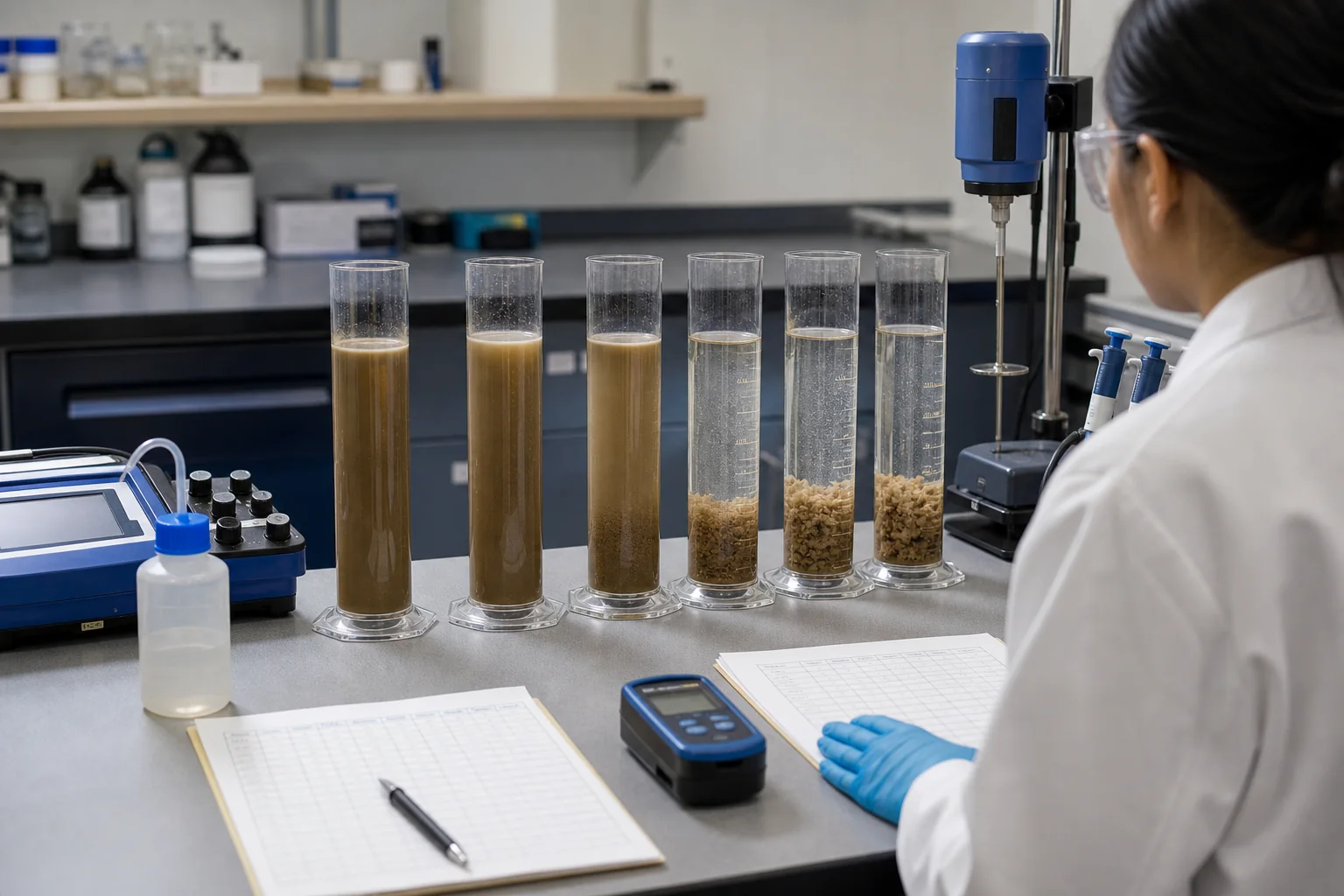
Record the water with every result
Measure pH, conductivity, hardness and temperature at minimum. Add alkalinity, dissolved metals or process-specific ions where they influence coagulation or mineral surfaces. Note the source used to prepare polymer stock.
A grade result without its water chemistry is difficult to reproduce after recycle concentration, rainfall or ore changes.
Understand chain conformation
Negative groups along the chain repel each other, while dissolved counterions can screen that repulsion. Changes in ionic strength and multivalent ions can alter effective chain extension, adsorption and solution behavior.
Use this mechanism as a reason to test, not as a shortcut to predict an exact grade from conductivity alone.
Track particle-surface changes
pH and reagents affect mineral and hydroxide surfaces. Primary coagulants can create positively conditioned patches that support anionic bridging. Recycle water can also carry residual dispersants or collectors.
Record addition sequence and pH after upstream chemicals, not just the untreated water value.
Compare preparation and process water
If plant performance is weaker than laboratory response, prepare the same polymer in both waters and test them on one homogenized slurry. Compare wetting, maturation, screen residue and dose response.
Avoid changing water, grade and stock concentration in the same trial step.
Build a chemistry matrix
Test finalists at normal and boundary pH, hardness or conductivity that the process actually experiences. Keep active dose and mixing constant.
Measure settling, clarity, compacted volume and shear recovery. Identify whether dose adjustment inside one grade is sufficient or an adjacent profile is required.
Create operating triggers
Link water measurements to observable process signals and approved actions. A rising conductivity trend may trigger a confirmation jar test rather than an automatic product change.
Retain representative process water or prepare a documented synthetic check only when it reliably reflects the plant.
Design a controlled water comparison
Split one homogenized slurry and prepare polymer stocks in the selected waters. Alternatively, prepare all stocks in one water and adjust only the test suspension when the question concerns particle interaction. State which design is used.
Changing both stock water and suspension water together can identify a practical difference but cannot show where the difference originates.
Evaluate hardness deliberately
Measure calcium and magnesium rather than relying only on total conductivity. Multivalent ions can affect chain conformation, adsorption and mineral surfaces differently from sodium-dominated salinity.
Test the actual operating range and avoid extreme laboratory additions with no plant relevance. Keep pH constant or report its movement when salts are added.
Evaluate pH without changing everything else
Use an acid or base compatible with the process and add the minimum required volume. Record pH before polymer and after any coagulant. Allow the suspension to equilibrate consistently before dosing.
A pH change can dissolve or precipitate surface species and alter primary coagulation. Interpret the full suspension response, not polymer charge in isolation.
Follow recycle-water concentration
Closed circuits can accumulate dissolved salts, residual polymer, dispersants and fine solids. Track conductivity, hardness and recycle ratio over time with the treatment result.
A fresh-water jar test may overstate performance when plant stock is prepared in concentrated recycle water. Use actual water during qualification and repeat after major circuit changes.
Set a retest trigger
Define chemistry limits that prompt a bench confirmation: for example a sustained conductivity or hardness shift, new coagulant, ore-source change or seasonal pH movement. The trigger should lead to measurement, not an automatic dose increase.
Keep an adjacent qualified profile and a retained sample when the process regularly crosses distinct water regimes. This shortens troubleshooting without claiming one permanent universal grade.
Distinguish chemistry from solids changes
When water and ore or raw feed change together, use a crossed test if enough sample is available: old water with old solids, new water with old solids, old water with new solids and new water with new solids. Prepare and dose consistently.
The matrix can show whether the main shift follows water, solids or their interaction. It avoids assigning every seasonal or recycle problem to ionic strength.
Document a practical chemistry history
Keep pH, conductivity, hardness, temperature, key reagents, grade, active dose and separation endpoints in one trend. Add rainfall, makeup-water source, ore campaign or cleaning events that explain discontinuities.
Use the history to choose representative qualification boundaries. It also gives technical sales enough context to recommend an adjacent sample without pretending one laboratory water covers the full plant year.
Confirm the boundary condition
Repeat the selected grade near the highest and lowest normal chemistry values with fresh suspension. Keep preparation, active dose and mixing fixed, then measure the same rate, clarity and compaction endpoints.
If one boundary fails, define a dose adjustment or adjacent product trial with explicit evidence. Do not extend the approved window beyond the chemistry actually tested.