
Define the purchase decision
A polymer described as suitable for hard or saline water still needs a site-specific test. Conductivity and hardness are different measurements, and neither one alone identifies the product that will work on the actual solids.
Keep the proposed product identity connected to the tested suspension and the intended separator.
Separate the relevant water inputs
Record makeup, recycle and polymer-preparation water sources. Measure pH, temperature, conductivity and hardness; add specific ions when justified by the process question. Recycle water may carry residual reagents and fines as well as dissolved salts.
The chemistry matrix distinguishes stock-water effects from the suspension interaction.
Compare without confounding the test
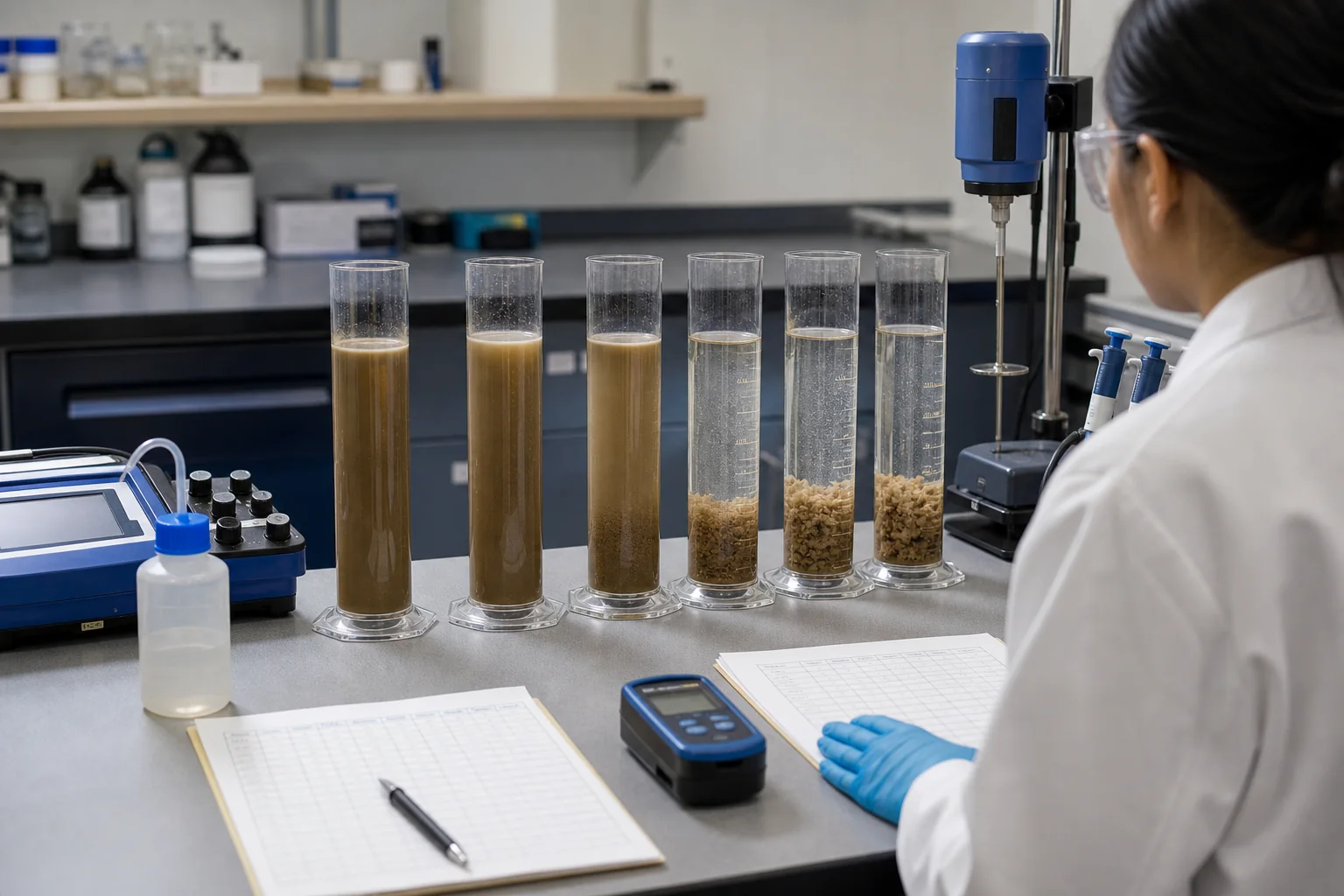
Split one representative feed and change the water factor deliberately, keeping grade, dose and mixing fixed. Where practical, cross old and new water with the relevant solids to investigate the driver. Avoid an extreme artificial salt addition that has no production relevance.
A practical difference can be real even when its mechanism is unresolved; procurement should not invent a molecular explanation to fill that gap.
Qualify a usable range
Repeat finalists at normal and difficult chemistry while measuring rate, clarity and compaction. Include preparation residue and delivered stock where water affects hydration. Determine whether one grade has a workable dose band or whether another independently qualified profile is required.
Compare treatment value across the demonstrated range instead of purchasing against an unsupported universal salt-resistance claim.
Check a misleading apparent improvement
If water conductivity increases while solids also change, a one-factor salt explanation is not established. Use a crossed comparison where samples permit and state remaining uncertainty. Procurement can approve a practical tested combination without claiming an unproven mechanism or promising the same result under every future recycle concentration.
Retain the comparison conditions and any unresolved acceptance requirement with the proposed purchase.
Set the release boundary
Record the chemistry boundaries actually tested and a trigger for confirmation when recycle concentration moves. Do not extend the order approval to untested pH, hardness or reagent combinations.
| Purchase requirement | Required evidence | Release condition |
|---|---|---|
| Water | Distinct source and chemistry records | Inputs are characterized correctly |
| Design | Controlled water comparison | Observed effect is interpretable |
| Boundary | Repeated separation range | Purchase has explicit chemistry limits |
Send a focused commercial request
Send normal and boundary water analyses, stock-water source, solids and residual reagents with trial results. State whether a representative difficult-water sample can be supplied.
Include quantity, package and destination with the sample and RFQ record. Review quality and supply controls with Gongyi Xinqi Polymer Co., Ltd.; confirm grade-specific terms and availability before ordering.
Request a product and supply review
Send the suspension, treatment route and proposed purchasing scope.