
Define the purchase decision
Higher anionicity is not a quality tier. Buyers need evidence that the proposed charge profile gives useful adsorption and bridging in the actual process water, without sacrificing clarity or underflow handling.
Keep the proposed product identity connected to the tested suspension and the intended separator.
Compare identifiable profiles
Ask suppliers to identify charge or hydrolysis methods and the molecular indicator used. If both charge and chain profile differ, compare the complete candidate rather than attributing the result to one number. Use the product-profile matrix to keep commercial codes distinct.
A nominal percentage from one analytical method should not become an equivalence limit for material measured by another method without a documented comparison.
Qualify the relevant water envelope
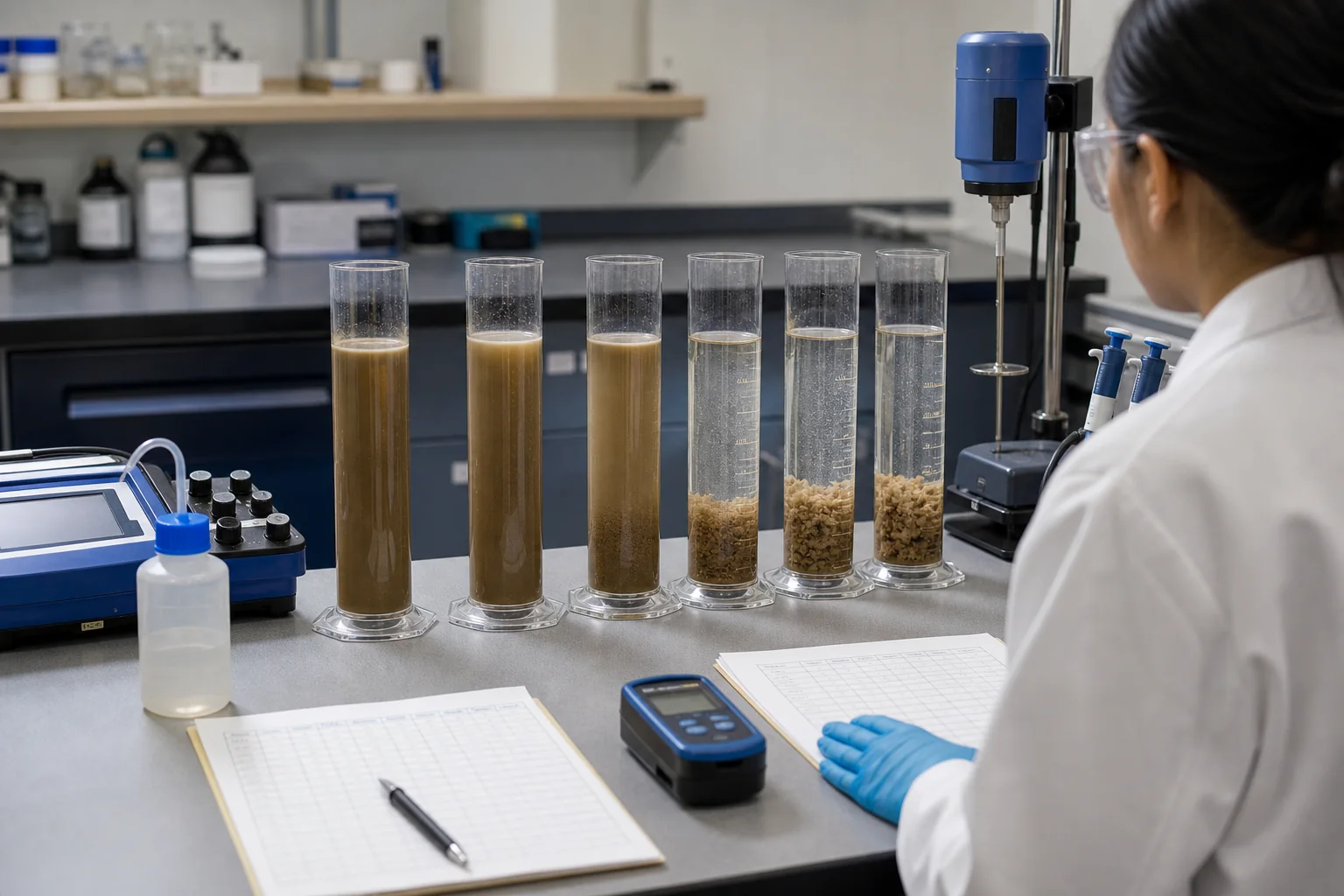
Run adjacent profiles on representative solids using normal and boundary process water. Keep preparation and dose basis constant. The water-chemistry procedure helps separate a change in particle interaction from a change in stock hydration.
Conductivity alone does not identify calcium, magnesium, dissolved metals or the surface condition created by upstream coagulation.
Award against a response band
Retain settling, overflow clarity, compaction and shear response across useful dose points. Compare normal and difficult feed before choosing the controllable middle band. A candidate with a sharp fast-settling optimum may be harder to manage than one with a broader acceptable window.
Include actual feeder accuracy and operating variation, not only the most favorable repeated laboratory point.
Check a misleading apparent improvement
If the higher-anionicity sample settles faster but leaves more fines, do not award against settling alone. Repeat at lower and neighboring doses, retain the same clarity sampling time and check compaction. The purchasing result is a candidate meeting the simultaneous plant limits, not a ranking of charge percentages.
Retain the comparison conditions and any unresolved acceptance requirement with the proposed purchase.
Set the release boundary
Approve a code and tested chemistry range rather than an unrestricted high-charge label. If the finalist has not been confirmed at plant scale, limit the initial order accordingly and leave production acceptance open.
| Purchase requirement | Required evidence | Release condition |
|---|---|---|
| Identity | Charge method and molecular profile | Comparison has a common meaning |
| Chemistry | Representative water and solids | Trial matches intended use |
| Control | Repeated dose-response band | Plant can hold an acceptable condition |
Send a focused commercial request
Send paired profile results, water measurements, solids source and the endpoint that limits production. Identify which candidate properties and trial conditions changed together.
Include quantity, package and destination with the sample and RFQ record. Review quality and supply controls with Gongyi Xinqi Polymer Co., Ltd.; confirm grade-specific terms and availability before ordering.
Request a product and supply review
Send the suspension, treatment route and proposed purchasing scope.