
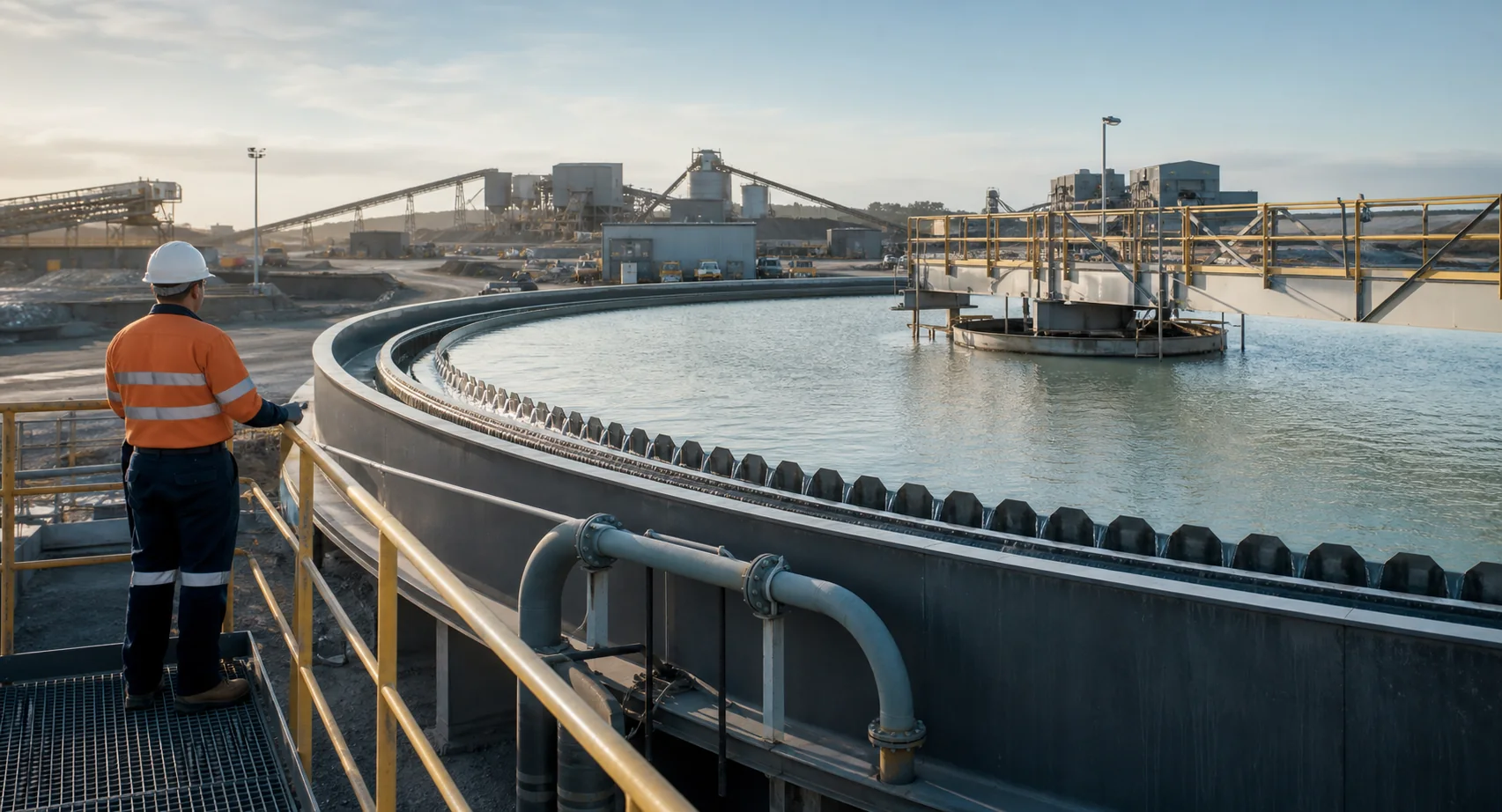
Define the purchase decision
A copper-tailings polymer can improve a local settling test while leaving return-water questions unresolved. Qualification needs the mineral feed, reagent history and actual water destination alongside thickener performance.
Keep the proposed product identity connected to the tested suspension and the intended separator.
Characterize the treatment history
Record solids concentration, particle distribution, water chemistry and known collectors, depressants or other upstream additions. Preserve the sample collection stage and time. A clean mineral suspension prepared only in fresh water may not represent the plant tailings.
The crossed water-and-solids comparison helps investigate which input drives a changed response.
Qualify the thickener duty first
Use adjacent profiles, controlled preparation and repeated dose curves. Retain overflow solids, settling, compaction, underflow handling and relevant bed observations. Do not substitute a photograph of clear water for a measurable endpoint.
Apply the feedwell method when distribution or dilution may control the result.
Keep metallurgical compatibility open
Identify the operations receiving overflow and agree the appropriate downstream tests with the plant team. Visible clarity alone does not establish absence of residual polymer effects or acceptable metallurgical response. Do not claim universal flotation improvement or harmlessness from a thickening-only trial.
Record whether compatibility was tested on actual recycle water, at which condition and with which result before broad supply approval.
Check a misleading apparent improvement
If a copper-tailings bench result uses water without the plant reagent history, treat it as preliminary screening. Repeat with representative water and solids before proposing plant savings. Any downstream compatibility check should use the intended return-water condition, not a synthetic easy sample that omits the unresolved process interaction.
Retain the comparison conditions and any unresolved acceptance requirement with the proposed purchase.
Set the release boundary
Release only the demonstrated process scope. If downstream water compatibility remains unresolved, identify that as an acceptance condition rather than projecting a bench settling benefit into an unrestricted plant recommendation.
| Purchase requirement | Required evidence | Release condition |
|---|---|---|
| Context | Mineral and residual reagent record | Candidate faces representative chemistry |
| Separation | Measured thickener outputs | Local benefit is established |
| Return water | Defined downstream confirmation | Approval does not exceed evidence |
Send a focused commercial request
Send tailings chemistry, reagent context, overflow destination, current thickener and metallurgical constraints. Separate completed thickening tests from pending return-water qualification.
Include quantity, package and destination with the sample and RFQ record. Review quality and supply controls with Gongyi Xinqi Polymer Co., Ltd.; confirm grade-specific terms and availability before ordering.
Request a product and supply review
Send the suspension, treatment route and proposed purchasing scope.