
Define the purchase decision
Concrete wash-water clarification concerns suspended material in a changing alkaline stream. Anionic polyelectrolyte selection does not by itself establish pH compliance or suitability of the recovered water for a particular reuse.
Keep the proposed product identity connected to the tested suspension and the intended separator.
Identify the collected feed
Record washout sources, solids concentration, storage time, pH and known admixtures. Cementitious material can continue changing during storage, so keep collection and testing times visible. Avoid treating an aged settled sample as equivalent to fresh production wash water.
Use the actual treatment route and an agreed sample-handling procedure for candidate comparison.
Separate chemistry duties
Clarify whether pH adjustment or another primary treatment occurs before polymer. If so, hold that stage fixed and record its effect. The sequence method applies when a separately controlled destabilization stage is part of the process.
Do not claim dissolved alkalinity removal from a clear supernatant or change neutralization chemistry merely to make one polymer sample perform better.
Evaluate the intended water circuit
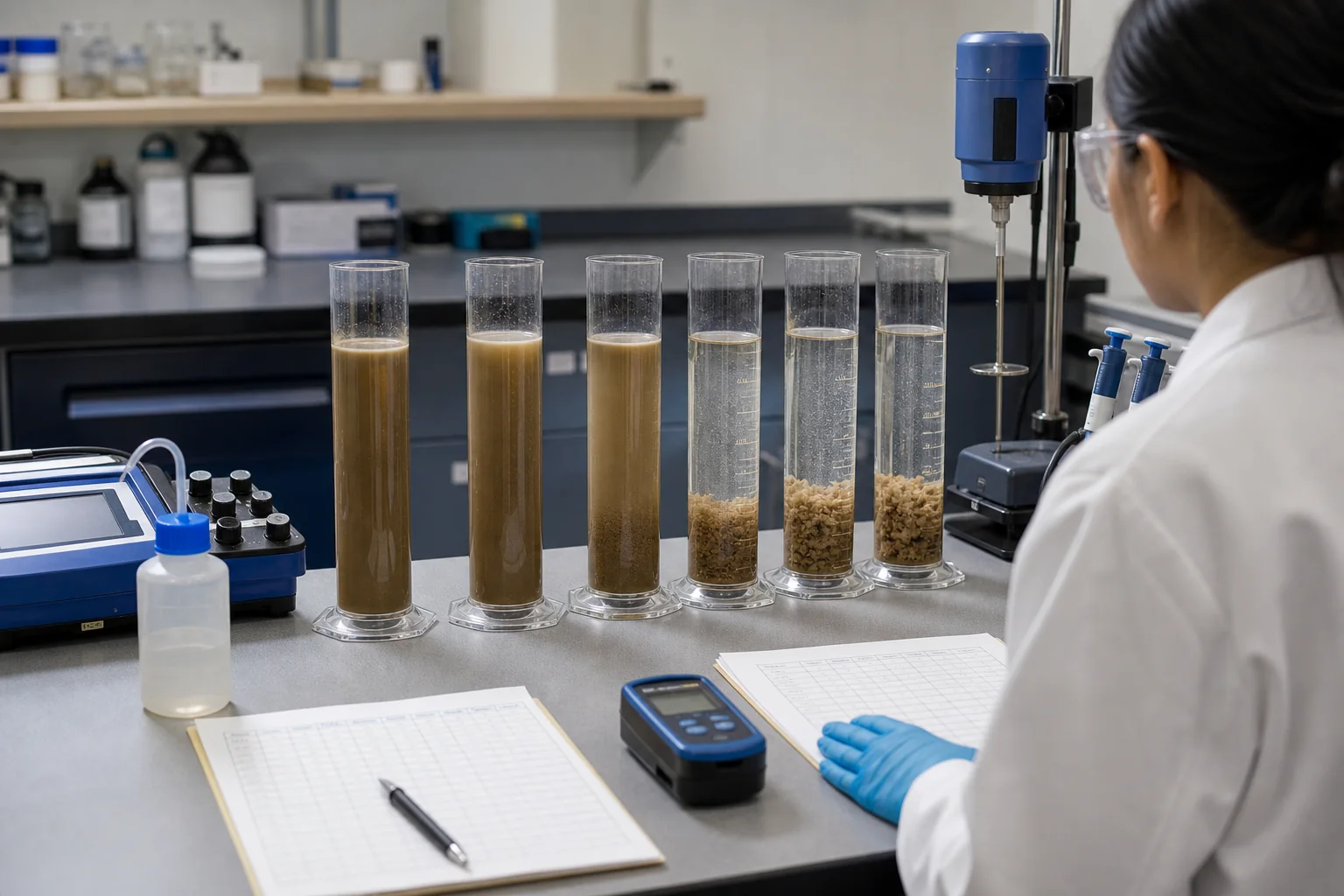
Measure residual suspended solids, settling and settled material removal, with actual recycle-water conditions. Reuse in a concrete process may have requirements beyond optical clarity; those need the applicable plant and quality review. The paired endpoint guide supports separation assessment without implying a reuse certification.
Include whether the settled material remains manageable through the intended holding and removal interval.
Check a misleading apparent improvement
If the supernatant looks clear while pH remains outside the separate reuse or discharge requirement, the polymer may have passed only the suspended-solids test. Do not broaden that result into whole-water acceptance. Keep the unfulfilled chemistry or quality requirement visible in the purchase and operating release.
Retain the comparison conditions and any unresolved acceptance requirement with the proposed purchase.
Set the release boundary
Limit approval to the tested solids-treatment duty and preparation route. Keep pH control, discharge permission and product-water acceptance as separate requirements rather than unsupported polymer benefits.
| Purchase requirement | Required evidence | Release condition |
|---|---|---|
| Source | Freshness, pH and admixture context | Feed represents the intended duty |
| Treatment | Defined primary chemistry | Polymer is not mistaken for neutralization |
| Output | Solids and handling evidence | Reuse claims remain separately assessed |
Send a focused commercial request
Send feed sources, pH, storage, any upstream treatment, separator and intended water use. Distinguish solids-separation targets from separate compliance or product-quality requirements.
Include quantity, package and destination with the sample and RFQ record. Review quality and supply controls with Gongyi Xinqi Polymer Co., Ltd.; confirm grade-specific terms and availability before ordering.
Request a product and supply review
Send the suspension, treatment route and proposed purchasing scope.