
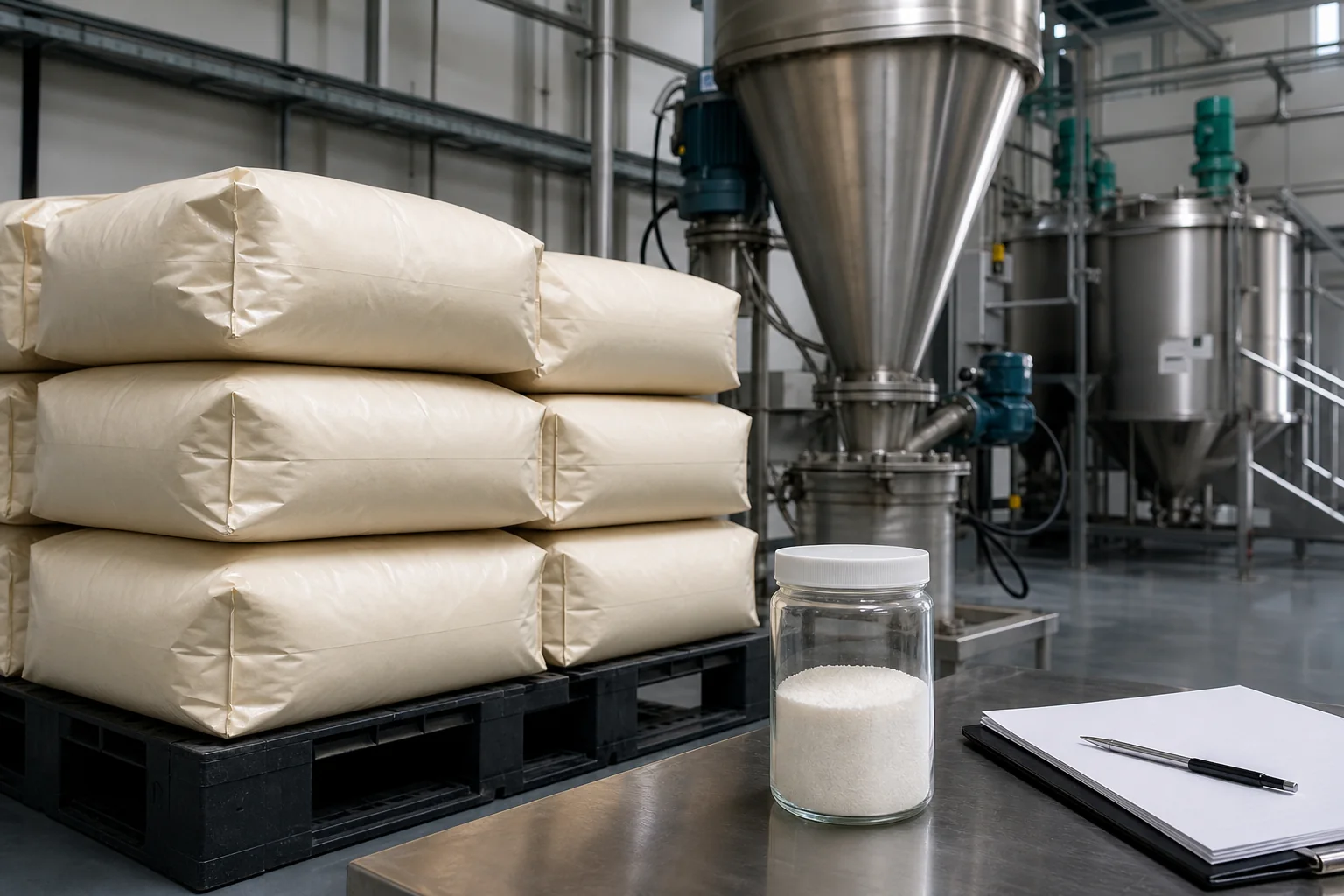
Keep powder and work area dry
Store sealed product away from leaks, condensation and damaged pallets. Follow the current SDS and plant handling procedure. Hydrated polymer on a floor is extremely slippery and must be contained and cleaned with a prepared method.
Inspect packaging, hopper and feeder for moisture agglomeration before starting a batch.
Control the make-down water
Record source, temperature, pH, conductivity and hardness. Establish designed water flow and mixing before powder feed. Compare plant and laboratory water when dissolution or application response differs.
Avoid assuming that clear water is chemically equivalent water.
Induct individual particles
Feed powder gradually into the designed wetting zone so particles disperse before their surfaces hydrate into a gel. Dumping into stagnant water creates rafts and fisheyes with dry cores.
Inspect the eductor, wetting cone, tank wall and feeder output for accumulation or pulses.
Choose a pumpable stock concentration
Use a concentration the mixer, transfer pump and lines can handle without stagnant zones. Higher concentration saves tank volume but raises viscosity and distribution demand.
Use secondary dilution near injection when it improves coverage. Keep the active-dose calculation separate from dilution-water volume.
Mature with controlled mixing
Provide enough initial energy for dispersion, then gentler agitation while chains hydrate. Calculate residence from working volume and peak draw, and prevent fresh stock from short-circuiting to the outlet.
Compare early and mature solution on one slurry if actual tank residence is uncertain.
Protect the solution after preparation
Review high-speed pumps, narrow valves, long recirculation and excessive storage age. Calibrate delivery against pressure and inspect for screen residue.
Keep grade, lot, water, concentration, start time, maturation, tank level and application result in one preparation record.
Verify feeder performance
Run timed catches or gravimetric checks at low, middle and high settings using the plant safety procedure. Compare actual powder mass with the controller output. Inspect bridging, rat-holing and vibration that can make an apparently steady feeder pulse.
Recalibrate after maintenance or product bulk-density changes. Record the result beside the solution concentration rather than treating feeder calibration as a separate document.
Calculate real maturation residence
Use working volume between the normal operating levels, not tank nameplate capacity. Divide by peak withdrawal and account for compartment short-circuiting. Continuous skids may need tracer or level-response observation to confirm effective residence.
If residence is shorter than required, reduce draw, correct sequencing or qualify performance at the actual age rather than assuming the nominal recipe is achieved.
Inspect solution quality
Use a consistent visual and screen check for fisheyes, undissolved particles and contamination. Track apparent viscosity only with a defined method and temperature. A high reading can coexist with poorly dispersed gel particles.
Compare a small prepared sample on a reference suspension. The application response links make-down quality to the function that matters.
Protect chains during transfer
Review pump type, speed, recirculation, narrow control valves and pressure drop. Sample before and after a suspected shear point and test both on one suspension at equal active dose.
When secondary dilution is used, ensure water enters with enough mixing for distribution but not at a point that sends formed floc through damaging equipment.
Manage stock age and tank hygiene
Record maximum approved solution age, turnover and cleaning. Long storage can change performance, while biofilm, residual incompatible chemistry or old gel can contaminate a new batch.
Use first-in-first-out logic where the skid permits it. Dispose of off-specification solution under the plant procedure and never compensate for degraded stock by raising dose without evidence.
Write startup and shutdown controls
Define the order for water, mixer, feeder, maturation release, transfer and dosing. At shutdown, prevent wet powder from remaining in the hopper or induction path and avoid stagnant old solution being mistaken for a fresh batch on restart.
Record abnormal stops and the solution age when operation resumes. Decide in advance when a tank must be discarded or requalified on a reference suspension.
Troubleshoot weak plant response systematically
First confirm grade and lot, then feeder mass, water flow, stock concentration, maturation, visible solution quality, pump output, dilution and injection. Compare plant stock with a freshly prepared laboratory stock on the same slurry.
This sequence separates product selection from preparation and delivery. Increasing dose before these checks can mask incomplete hydration and create excess chemical consumption without restoring stable separation.
Train against observable checkpoints
Give operators visible checks for dry feeder behavior, wetting, tank level, maturation release, screen residue and pump delivery. Pair each abnormal observation with a safe corrective action and escalation point.
A concise shift record should show product lot, batch time, concentration, solution age, process flow and active-dose calculation. These checkpoints turn make-down quality into a controlled operating input.